 “Ah, it’s finally Sunday and I can spend all day in bed! I might take the opportunity to plan that project though, so I can meet that new client on Monday… What about little Mark? He’s been asking me to take him to the playground all week! But today Carl asked me to lunch at that romantic restaurant to celebrate our first year together!”
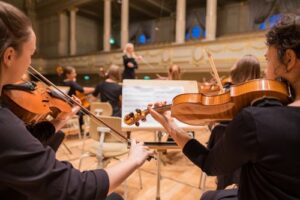
Who hasn’t experienced something similar in the head? Just like in an orchestra there are many musical instruments with different scores and each one has its own role: the lazy part that wants us to stay in bed, the workaholic part that wants us to work harder, the perfect parent who wants us to take care of the children and so on.
Each of these figures has its own character and needs, often in conflict with the others.
Roberto Assagioli, father of the psychological theory of psychosynthesis, called them subpersonalities. Over the course of our lives, true inner personas have formed. Some have come to life from a more pronounced side of the character, others from the conditioning of family or society. The majority of them, however, were born as a response to a need. For example, as a child I needed my mother’s love and she rewarded me when I was good: I learned to be good to get what I want and the “Good” has become my subpersonality.
With some of these we have no problem but it is against those we judge as negative that we fight our daily battle. “I’m never satisfied with what I do! I’m always critical of myself!” might be said by someone who spends his nights writing and rewriting the same practice. Yet it may be that it is precisely his critical side that has allowed him to achieve the greatest results of his life, pushing him beyond his limits. Subpersonalities are neither positive nor negative, but functional or dysfunctional.
Let’s think about a histrionic subpersonality, this can be functional if I am a trainer and I am teaching a training course, because it will help me be engaging and keep the attention of the group. The same subpersonality however can be dysfunctional if I am at my best friend’s wedding and I am doing everything I can to be the center of attention.
In fact, the main problem with subpersonalities is that we don’t normally choose when to use them, they come into play automatically. Over the years we have learned that responding to a stimulus in that way works and we continue to do so. It’s like we have a series of musical instruments but they play without choosing the right time or following a melody.
In order to be the conductor of your own orchestra, the first thing to do, on your own or with the help of a specialist, is to recognize your subpersonalities. It may be helpful to draw them, give them a name and a character. You can then experience identification – acting, feeling and thinking like that character – and disidentification – returning to the initial state of calm.
Recognizing one’s own subpersonalities, identifying oneself, disidentifying oneself, understanding where they are useful and where they are harmful and acting in the light of this awareness is the way to become the conductor of one’s own inner orchestra and make all the instruments work together for our harmony and happiness.
First published on the Coach Irene Morrione website: www.irenemorrione.it
Image from the free website unsplash.