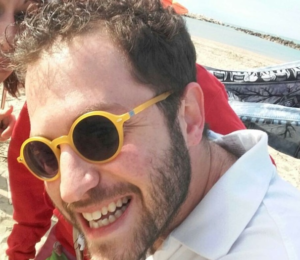
 Do you know what your dream is? Your “I’d love to” and “I wish”? The time has come to turn them into something concrete, otherwise, as Begger Vance of The Legend says, in time, you will forget what your swing is: that thing that makes you vibrate, that is yours and that no one can take away from you. I have chosen a living example of tenacity and positivity to carry this message: Giorgio Graziotti (you can follow him on Facebook). Giorgio was the first disabled person from the University of Tuscia to go on Erasmus, overcoming his limitations and realising his dream.
Let’s listen to his testimony.
- How did the idea of Erasmus come?
I had been thinking about it for a while, I wanted to gain experience abroad and get involved. I also wanted to improve my Spanish and test myself in the world of work. - What was stopping you from doing what you wanted to do?
I had many fears and doubts, such as “Who will be my companion?”, “What if I don’t get on with him?”. It was my first experience outside the “nest” and I was afraid I wouldn’t be able to cope. At one point, I was so full of doubts that I didn’t want to go! - A complete upheaval of your life and routine terrified you… of course! And then what happened? What made you take the first step despite your fears?
My saying is “carpe diem”, so at some point I said to myself “I’m in the game, let’s dance!”. I won’t hide the fact that a fundamental role was played by my mother, who always supported me and encouraged me to overcome my mental limits! - So can we say that even when limitations seem objective, as in your case (not being able to walk, write, etc.) it is actually all in our heads?
Absolutely! In my case, I found two people who were beautiful on the outside and on the inside, who accompanied me in my first two Erasmus experiences (yes, the first one was followed by two more, always in Spain). During my last move to Spain, I managed to realise my dream of working as an apprentice journalist in the editorial office of Servi Media and they even published one of my articles! - Wow! So, once you get past the first moment that stops you from taking the first step, it’s all downhill from there?
Absolutely not! There were some very difficult moments for me. Such as the relationship with the editor-in-chief, my first tutor in Madrid, and with my third tutor. - What helped you to overcome the difficulties?
Reminding myself that I could count on myself. - So, can you say that you had high self-esteem?
It’s not so much having it, the point is that when you’re in my physical condition, therefore unable to be autonomous, and you also have an uncaring companion (like during my third Erasmus experience) the only person you can rely on is yourself! - It seems to me a very good point. I often hear the phrase “I don’t trust myself enough”, but, like you, I think it’s just a matter of challenging yourself and overcoming obstacles, rather than dodging them, to see what happens. What would your life be missing if you hadn’t faced that test?
Practically everything! I would miss knowing and trusting myself, being aware of my limits and at the same time being able to take risks, being open-minded, being able to put myself in the other person’s shoes (I have met people who have been able to see beyond their disability). - In conclusion, what would you recommend to those who want to start a new adventure but are afraid and do not know what to expect?
To stop telling themselves stories and do a reset. To see in front of them a blank page to write and observe what comes out… as if it were a game that makes you curious! - Thank you so much Giorgio, your testimony was really precious!
Thank you for giving me the opportunity to talk about it.
If you are interested in Giorgio’s story, you can find a detailed account in his book, written together with his friend and copywriter Fortunato Licandro (more info on the website).
If you want to start working on your limits, through a programme where you will be followed step by step to get the results you want, try coaching.