 Do you often feel bad after a fight with your partner or a friend and regret what you said? Or to come back home after a day’s work in which perhaps you have discussed with someone, softly, because – you know – it’s work, and to feel hurt? Or even to find yourself in front of your boss, or any other authoritative figure, and not being able to say what you would like, having a sense of frustration throughout the day or maybe even more?
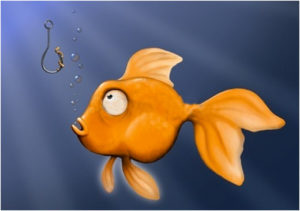
If you recognize yourself in at least one of the above situations (of course I could mention many more) it means that you have been “emotionally hooked“. Any situation that triggers an automatic response in us is an “emotional hook“.
The hook is something that developed during our growth and that is connected to our vulnerable areas. For example, with an aggressive parent I might have developed a victim’s attitude and so every time someone uses aggressive tones with me I might start thinking “I’m not good at anything!”, “He’s right, I’m just a bad person …”, ” I’m worthless! “and so on. Or on the contrary, I could have developed an attitude of persecutor and when I see someone more fearful or insecure I might feel angry and treat him/her badly (who is interested in particular to understand how the figures of persecutor and victim work, can deepen with the explanation of the dramatic triangle of Krapman: https://www.karpmandramatriangle.com/pdf/DramaTriangle.pdf).
It is like if, no matter which, one part of us prevailed and decided what we have to do.
Roberto Assagioli would call them subpersonalities, just as if within us, over the years, characters were developed who come into action when they are solicited.
Is there a way, you are probably wondering, not to get hooked and get rid of these automatisms?
There are in fact many tools, the choice of which depends mainly on our objectives and the time and money we have to invest.
You can certainly start with a simple exercise, for which you will need 1 hour of your time, some sheets and a pen. People who like it, can put a relaxing music on.
Divide the sheets in half and on the left column, list minimum 3 and maximum 5 situations in which you have been hooked by something that someone else did or said.
Further, divide the right column creating the “Me” column and the “someone else” column.
For each situation described, in the “Me” column write down how you experienced the situation and what you thought in 1st person (for example: my boss was aggressive with me, I thought I was incapable …), in the column “someone else ” how an external person would objectively describe the situation and what would think, talking about you in 3rd person (for example: Giulia’s boss spoke loudly – in fact aggressiveness is an interpretation-, I thought they were discussing something important…)
This exercise, done from time to time, allows you to start recognizing the situations that hooks you and start detaching to be more in power of your life, reduce the stress and feel more peaceful.
Did you like it? Leave a comment and tell me how it was!
Do you want to continue working on emotional hooks and achieve lasting serenity? Try coaching!